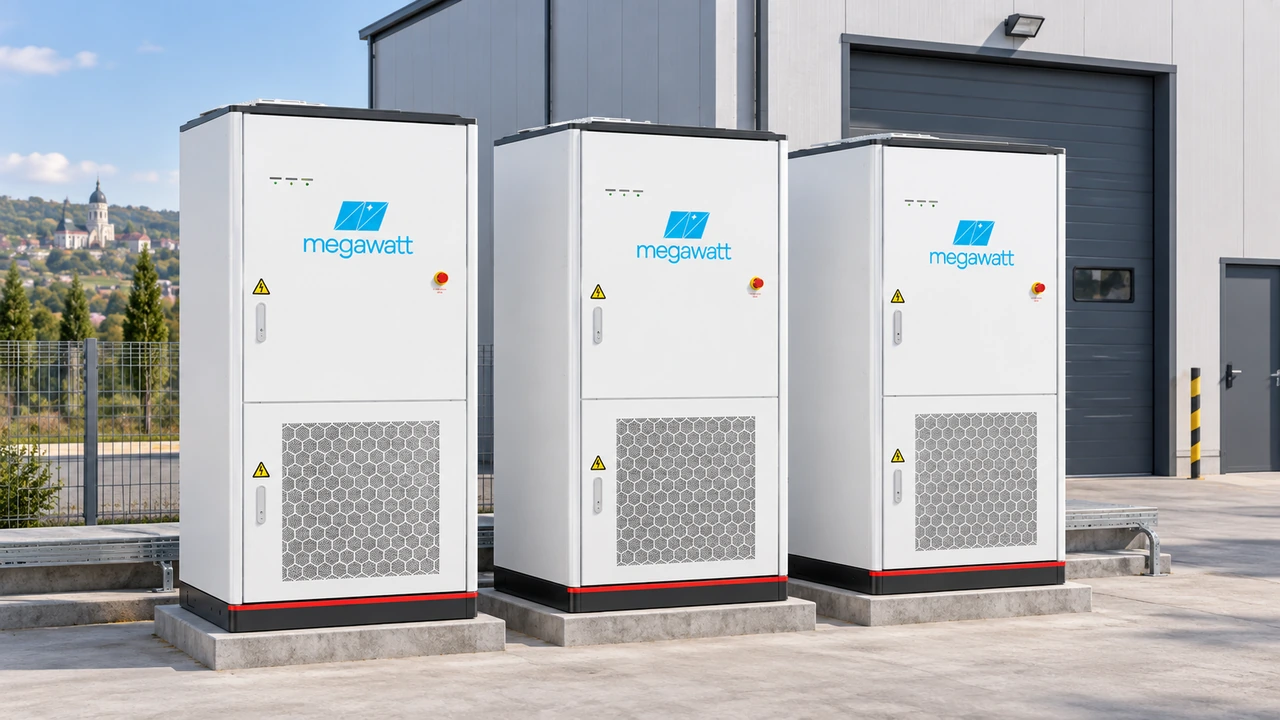
Megawatt provides BESS systems for businesses in Moldova, designed around the load profile, solar installation and operational objectives. A correctly sized solution can increase solar self-consumption, manage demand peaks and support essential processes when backup functionality is included.
What is a BESS for businesses?
BESS stands for battery energy storage system. It stores electricity and supplies it later according to the operating strategy. A complete solution includes battery modules, bidirectional power conversion, a battery management system, an energy management system, protection, temperature control and monitoring.
Combined with a solar installation, BESS makes a larger share of solar production available for on-site use. Storage supports flexibility, energy efficiency and renewable integration, as described in the European Commission overview of energy storage.
What Megawatt provides in a BESS project
Megawatt designs and integrates the system as a complete solution for the business, not simply as a battery. The service can include:
- analysis of load profiles, consumption and power peaks;
- definition of the use case and priority loads;
- selection of power in kW and capacity in kWh;
- integration with solar generation and electrical infrastructure;
- EMS, communications, protection and monitoring configuration;
- testing of the designed operating strategies and functions.
The benefits of battery storage for businesses
Use more of your solar energy in your own operations
A facility producing surplus solar electricity at midday can store it for use later, when operations need it. This allows the solar installation to cover a larger share of on-site demand, including beyond peak generation hours. Consumption and generation measurements identify how much energy can be shifted effectively.
Direct solar consumption and storage complement each other. Scheduling equipment during sunny hours uses electricity without additional battery losses, while BESS makes the remaining surplus available later. Combining both approaches helps match solar output to the business's operating schedule.
Reducing short periods of high power demand
Several machines starting or operating together can create brief periods of high demand. A correctly sized BESS can help reduce the power drawn from the grid during these periods.
Managing demand peaks gives a business more flexibility in using its electrical infrastructure. Associated savings depend on the tariff and supply contract; reducing peak power does not automatically reduce the bill. The design identifies relevant benefits while respecting approved connection capacity and operating conditions.
Supporting priority processes during outages
With a dedicated backup configuration, BESS can support essential cold storage, processing equipment or information technology during outages. Identifying priority loads directs investment towards the activities where continuity matters most.
The design must specify island operation, safe grid separation, an acceptable transfer time and a suitable energy reserve. Compatibility with existing generators and uninterruptible power supplies must be assessed for sensitive processes. Backup capability should be confirmed through the agreed commissioning tests.
Sizing industrial batteries around business needs
Power, measured in kW, describes how quickly the system can charge or supply equipment. Energy capacity, measured in kWh, describes the quantity of energy available over a period of operation. These values must be considered together.
A constant 100 kW load operating for two hours requires 200 kWh at the system output in an idealised calculation. The required nominal battery capacity must then account for usable energy, losses, operating reserves and degradation. This example illustrates the relationship between power and energy; it is not a specification for a particular facility.
An initial assessment benefits from:
- at least 12 months of electricity bills and consumption records;
- demand profiles at 15-minute intervals or greater detail;
- generation and export data from the existing solar installation;
- working hours, seasonal changes and planned expansion;
- approved connection capacity, electrical drawings and transformer information;
- priority loads and the required backup duration.
System integration and energy management
The energy management system, or EMS, determines when the battery charges, when it supplies electricity and how much reserve remains available. Its operating strategy should reflect the tariff, solar generation, loads and the owner's priorities.
EMS settings balance daily battery use with an outage reserve. Simulation allocates the available energy between these objectives without counting it twice, creating an operating strategy matched to business priorities.
Integration also requires checks of inverters, switchboards, protection systems, communications and metering. Installation planning must consider temperature, maintenance access, environmental exposure and fire protection. Manufacturer documentation and applicable site requirements must be incorporated into the engineering design.
An investment built around measurable benefits
Megawatt compares operation without storage against a BESS scenario using the same demand data. The assessment considers grid purchases, solar self-consumption, exports, power peaks, losses and the control strategy.
The proposal should cover the complete installation: batteries, conversion equipment, EMS, electrical and civil works, commissioning and services. Maintenance, auxiliary consumption and degradation are included in the operating assessment. This provides a measurable basis for selecting the configuration and evaluating its economic potential.
Financing options for business battery storage
The project may be funded from the company's own resources, an investment loan or an available green finance facility. Consumption data, a technical concept, an itemised quotation and a benefits simulation create a stronger financing file.
One option to consider is GEFF, the EBRD's Green Economy Financing Facility. The conditions published by maib cover preapproved technologies and individually assessed projects. System eligibility and lending terms should be confirmed before purchase; the referenced product has no grant component.
How a BESS project starts with Megawatt
Through its industrial energy storage service, Megawatt turns energy data into a practical technical solution. An initial assessment benefits from at least 12 months of consumption records, load profiles, solar installation information, the electrical scheme and a clear project objective.
The process continues with scenario modelling, power and capacity selection, integration design, control configuration and system testing. The result is a BESS engineered for the way the business actually operates.
Frequently asked questions about BESS
Can storage be added to an existing solar installation?
Yes, subject to equipment compatibility and electrical architecture. The electrical scheme, protection, communications and control strategy require assessment before a suitable configuration can be selected.
Can a battery supply the entire business?
Yes, when its power, usable energy and backup architecture are designed for that purpose. A system can serve the entire business or selected priority processes, depending on operational needs and the planned investment.
Can a BESS operate without solar panels?
Yes. A system designed to charge from the grid can manage demand peaks or maintain an energy reserve. Its usefulness depends on tariffs, loads and the electrical configuration; solar panels are not an essential requirement.
Megawatt can help turn stored energy into a business advantage. Share your load profile and project objective to receive a BESS assessment tailored to the site.